Where the orders came from
Alvy Logistics and DSI Transportation take a large part of their courier work by email: a request with the pickup, the delivery and the time window, sometimes with a PDF or an image attached. Until the intake went live at the end of June 2026, the dispatch team read those emails in a shared inbox and keyed each job into the dispatch system by hand: the account, both addresses, the time windows, the references and the service level. Replies about jobs already booked arrived in the same inbox, so someone opened each one to see whether it changed anything.
What we built
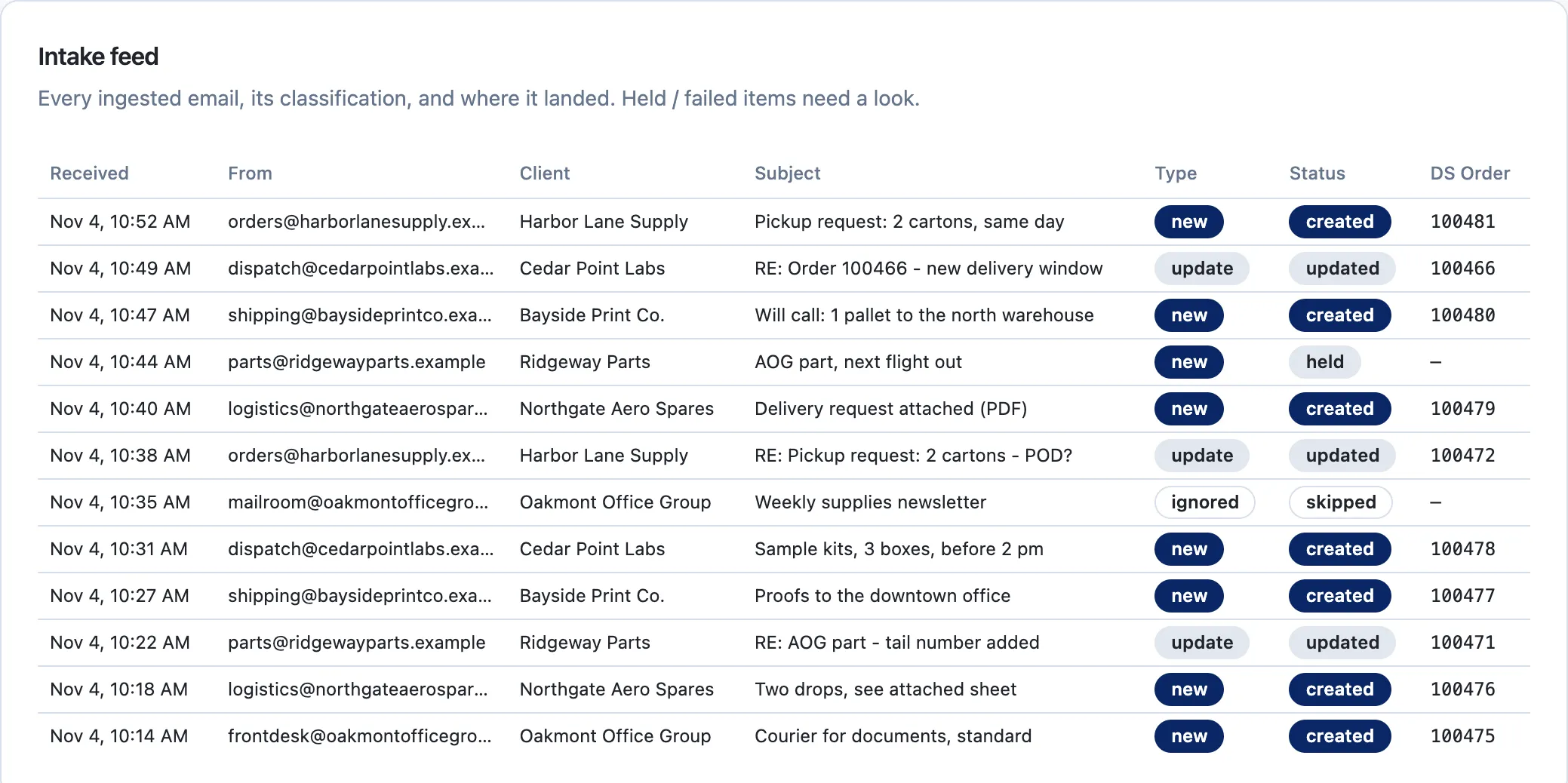
The order intake is one part of AlvyOne, the operations system Alvy and DSI share. It checks the order inboxes every minute and sorts each new email: a new job, a reply about a job it already built, or not an order.
- It files what isn’t a new order: a reply goes on the job it belongs to, and blocked senders and work that belongs somewhere else are set aside.
- It reads the order: from the email and any PDF or image attached, it takes the pickup and delivery addresses and time windows, the vehicle, the service level, the client’s reference, pieces, weight and dimensions, and the notes. It also lists anything missing or unclear.
- It finds the account: it works out which client sent the order from the sender, the reply-to address and the signature.
- It applies each account’s rules: the account’s address book, its service levels and the printed formats its orders use, plus a table of airline cargo doors.
- It creates the order: it checks the address, checks that the order isn’t already in the dispatch system, then prices it and creates it through the dispatch system’s API.
Every job it builds posts to the dispatch team’s chat, so the team sees what came in, and a daily summary of the builds posts there too.
When an order isn’t clear
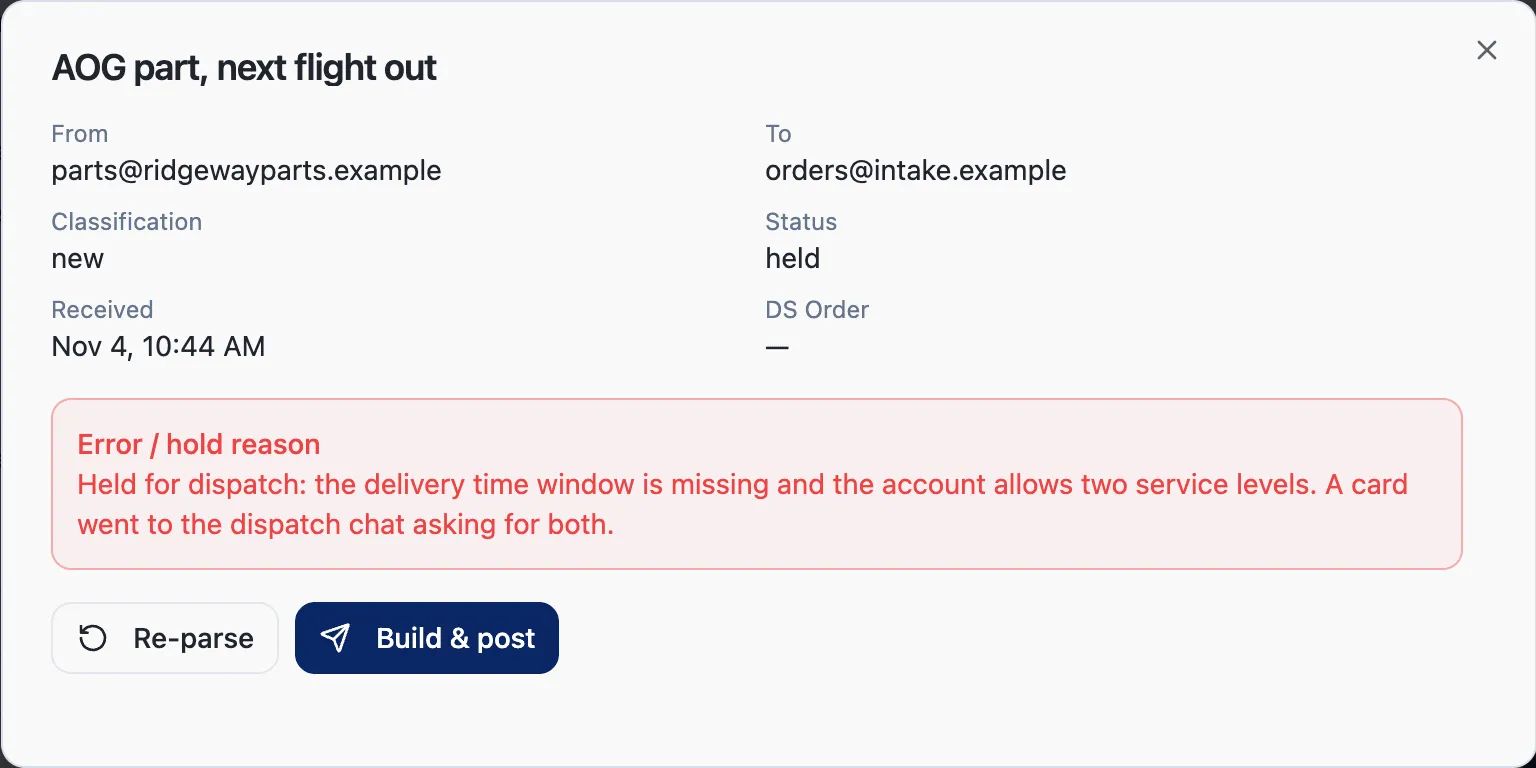
The intake doesn’t guess. When a detail is missing or unclear, it holds the job, and a card in the team’s chat says what is missing. A dispatcher answers there or builds the job by hand, and a held job gets a reminder every hour until someone does.
The cards come from the dispatch assistant Alvy’s staff use in their team chat. It finds jobs, answers status questions, and can edit or cancel a job or assign a driver in the dispatch system, asking the dispatcher to confirm before a risky change.
The intake stops at the order. No driver is assigned automatically: that stays with the dispatch team.
How we run it
We built the intake with Alvy’s team and we run it with them. Running it means watching it every day:
- A health report every 15 minutes goes to our own admin system, and a late report is flagged.
- Daily checks watch the AI models it uses and the AI provider’s status.
- When the AI provider fails, the intake retries. When the retries run out, dispatch is told to build the job by hand. If the main reader fails, a second model reads the email.
- Spend guards alert us when AI costs run high. The intake pauses itself only when one sender floods an inbox.
- Two switches stop it at once: one for posting orders, one for reading the inboxes.
- Staff sign in with two steps, and what each person can see follows their role.
The work didn’t stop at launch. New order formats and new rules arrive every week, and the intake changes with them.
What AlvyOne has done so far
Each figure comes from AlvyOne’s own records, read on November 1 and 2, 2026, and carries its own dates.
- 13,554 jobs built from email for Alvy and DSI, June 30 to November 1, 2026. Over the same months the intake sorted about 198,300 emails: replies filed on their jobs, emails that weren’t orders set aside, and new jobs.
- 69% of the two companies’ new orders were created by AlvyOne, October 3 to November 2, 2026, from email or from its one-click builds of daily routes and recurring runs. For DSI, 61% of new orders came straight from client emails, against none before the intake’s first orders on June 30, 2026.
- A median 38 seconds from email to order, October 3 to November 2, 2026, across 2,919 orders, with 84% in the dispatch system within a minute.
- 91.4% of new-job emails became orders with no person stepping in, October 3 to November 2, 2026. The other 8.6% were held for a dispatcher, as above.
- Jobs from email arrive about one every six minutes through the working day: 8 a.m. to 5 p.m. Pacific on weekdays, September 7 to November 1, 2026, and at the weekday peak, a new job about every five minutes, from 11 a.m. to noon. Across the whole weekday, about 121 jobs came in by email.
- About 0.4 cents of AI per order built, October 8 to November 2, 2026: what the AI that reads and sorts the emails costs, before hosting.
What changed, and when
- September 7, 2025: the AlvyOne build starts.
- June 29, 2026: the email intake is switched on.
- June 30, 2026: the first orders built from email, for Alvy and DSI on the same day, and built jobs start posting to the dispatch team’s chat.
- July 3, 2026: the first version of the dispatch assistant in the team chat.
- July 7, 2026: the daily summary of builds starts.
- October 9, 2026: order reading moves to a newer AI model, with a larger one as the safety net, and reading one email costs about 15 times less.
- October 10, 2026: the dispatch assistant takes requests with several steps.
- October 11, 2026: the check against orders already in the dispatch system.
- October 12, 2026: the assistant starts writing the hold cards.
- October 23, 2026: dispatchers can confirm a client’s account in the chat, and sign-in takes two steps.
Most orders that arrive by email are now built by the intake, and the dispatch team handles the ones it holds. Read how order entry automation works for other businesses, or what AI automation covers.